This excerpt from our Road Rally Handbook describes it best:
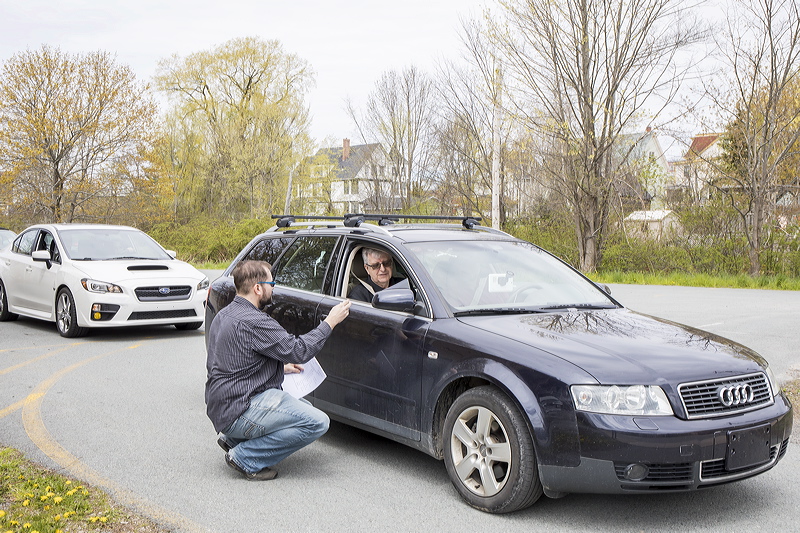
A road rally is a form of car-based competition that is fun and challenging, while maintaining a high level of safety. A team of two, made up of a navigator and a driver use a set of instructions to follow a specific route. A further complication is that they are required to maintain a specific average speed (always below the posted limit). At intervals along the route, the organizers will have set up secret control locations. When the competitors encounter one of these checkpoints, their time will be checked and a score computed based on an ideal time. They will then proceed along the route to the next checkpoint where the process is repeated. The team is awarded penalty points if they arrive earlier or later than their ideal time. When all these points are added up at the end of the rally, the team with the lowest score is declared the winner.
The challenge in a road rally is following the route instructions and maintaining the assigned speeds. Success requires teamwork. The navigator interprets the route instructions and instructs the driver while also ensuring that the correct speed is being maintained. Teamwork is crucial!
When designing the route, organizers make sure to set average speeds below the speed limits for the roads traversed. Competitors should never feel the need to speed or drive unsafely to meet time goals. The goal of a Road Rally is precision, not risk.
Other names used for a Road Rally are Navigational Rally, Navex Rally or TSD (Time, Distance, Speed) Rally.

What do I need to compete?
The first requirement is a road legal vehicle. Almost anything will be fine. Organizers will usually identify a road rally as being tarmac only, or tarmac and gravel. A low riding sports car is probably not a good choice for a tarmac and gravel rally, but any other vehicle should be good. If you plan to use a low riding vehicle, tarmac only events will be a good choice. If you are unsure, ask the organizer. They have the experience and knowledge or the route and can make recommendations.
The driver must be legally allowed to drive. The navigator does not require a driving license and can be any age. Young navigators may need a parent to sign a waiver before they can take part. Both team members must be members of one of the regions motorsport clubs. One day memberships are usually offered at a very reasonable price.
It is possible to compete with no additional equipment for the navigator. Just follow the route, use the vehicle’s odometer to track distance and drive about 5% above the designated speed to account for slowing for stop signs, turns etc. This should get you close to the ideal time.
In practice, most navigators will have at least pens, paper and a clock/watch set to official rally time.
See our complete manual for further information. We suggest you print or download a copy and have it with you during rallies!
 Road Rally Development Group